
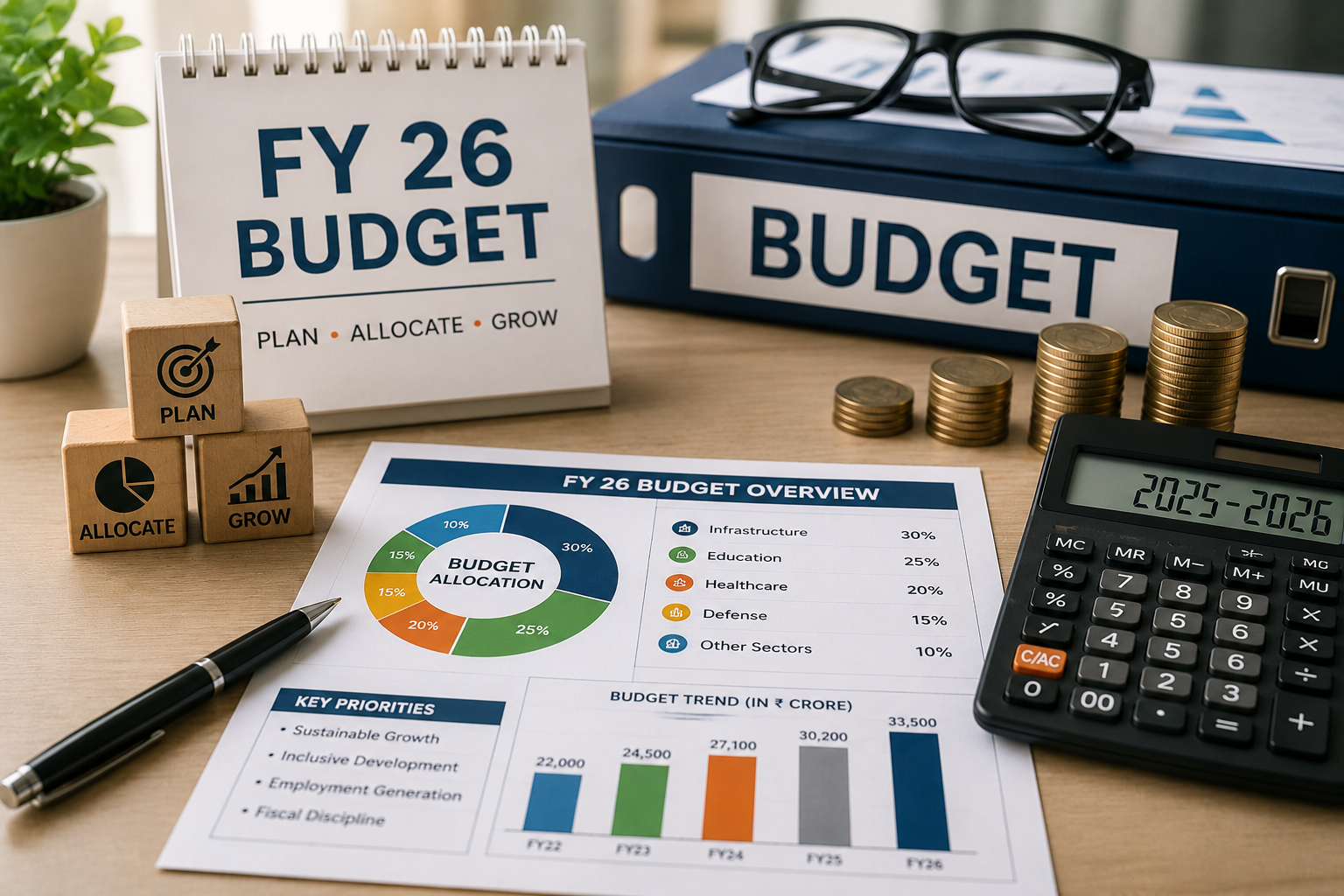
The Union Budget for FY2025–26 was presented on 1 February 2025. For investors, one of its most visible changes was personal income tax, while the broader budget also focused on growth, infrastructure, agriculture, manufacturing and household demand.
The headline change: personal income tax
The Budget proposed a revised personal income-tax structure under the new regime. It stated that there would be no income tax payable up to total income of ₹12 lakh, excluding income taxed at special rates such as certain capital gains; for salaried taxpayers, the effective threshold was ₹12.75 lakh after the ₹75,000 standard deduction.
The revised slabs were: up to ₹4 lakh nil; ₹4–8 lakh at 5%; ₹8–12 lakh at 10%; ₹12–16 lakh at 15%; ₹16–20 lakh at 20%; ₹20–24 lakh at 25%; and above ₹24 lakh at 30%.
Tax relief can become a wealth-building opportunity
For a household that sees a lower tax outgo, the long-term benefit depends on what happens next. Extra cash can be consumed, held idle, used to reduce expensive debt or directed toward long-term investments.
Capital gains remain a separate consideration
The ₹12 lakh threshold did not mean every type of income becomes tax-free at that level. The Budget speech specifically excluded special-rate income such as capital gains from the statement about no income tax up to ₹12 lakh.
This distinction matters for investors who receive salary or business income alongside capital gains. Portfolio decisions should consider both ordinary income and investment-gain taxation.
What the Budget means for portfolio decisions
- Review whether your tax regime is appropriate for your circumstances.
- Direct sustainable savings toward clearly defined financial goals.
- Do not increase investment risk simply because disposable income has increased.
- Review emergency reserves, protection and expensive debt before increasing market exposure.
- Keep tax planning separate from product selection.
Beyond income tax
The FY26 Budget also addressed infrastructure, agriculture, manufacturing, small businesses and investment-related measures. It proposed tax certainty for certain Category I and II AIFs investing in securities and extended the investment window for sovereign wealth and pension funds investing in infrastructure.
Ask “What changes for my cash flow, taxes, goals and portfolio?” rather than “Which stock will benefit tomorrow?”
The bottom line
The FY26 Budget created meaningful changes for individual taxpayers, particularly under the new tax regime. The wealth-building opportunity comes from turning policy changes into better financial behaviour: saving deliberately, investing consistently, managing taxes intelligently and staying aligned with long-term goals.
Union Budget 2025–26 – Ministry of Finance
Budget Speech 2025–26
This article is for education and general information only. It is not a recommendation to buy or sell any security or financial product. Tax rules, market conditions and regulations may change.
Our perspective
Turn policy changes into better financial decisions.
Tax rules can change, but the principles of disciplined wealth creation remain. Review your cash flow, goals, tax position and portfolio together rather than in isolation.
Discuss Your Portfolio